
The Fracture of 2026: How the Maduro Arrest and Zambia’s Pivot Are Redrawing the Global Map
Top Story
•
January 3, 2026
•
17 Views
By Ryan S Taylor
Date: January 3, 2026
The confirmation of Venezuelan President Nicolás Maduro’s detention by U.S. forces this morning has fundamentally altered the geopolitical landscape. This event, combined with the U.S. administration's immediate expansion of the immigration Exclusion List to include Zambia, marks the definitive end of the post-Cold War diplomatic order. For global industries, specifically Internet Services and Energy, the era of a unified global market is effectively over.
The repercussions are being felt most acutely in the Global South, where the leadership styles of Nigeria, South Africa, and Zimbabwe face a reckoning. The "dictatorial style" of governance in these nations, often characterized by the suppression of dissent and reliance on opaque patronage networks, has suddenly lost a key ideological and financial pillar in Caracas.
The End of the "Black Budget" and the African Impact
For years, intelligence analysts have pointed to a flow of illicit funds—often termed the "Black Budget"—moving between the Maduro regime and allied elites in Africa. The arrest of Maduro disrupts this network immediately. In Nigeria, South Africa, and Zimbabwe, ruling coalitions that have relied on anti-Western rhetoric to mask internal mismanagement now face a crisis of liquidity and legitimacy.
In South Africa, the Government of National Unity finds itself in a precarious position. Having long shielded controversial figures under the guise of diplomatic neutrality, Pretoria must now navigate a world where the U.S. has demonstrated it will physically dismantle regimes it deems criminal enterprises. The silence from the Union Buildings today is deafening, likely stemming from the realization that the immunity of sovereignty is no longer guaranteed for leaders who operate outside international legal norms.
Zambia and the Currency War
While the Caracas operation dominates the headlines, the economic war has opened a new front in Lusaka. Zambia’s decision to officially operationalize the acceptance of Chinese Yuan (Renminbi) for mining tax payments has triggered swift retaliation. The inclusion of Zambia on the U.S. Exclusion List, effective January 1, 2026, serves as a brutal warning to the rest of the continent: economic alignment with Beijing will come at the cost of access to the West.
This "Zambia Model" of de-dollarization poses a systemic threat to the U.S. financial hegemony. By allowing copper—a critical mineral for the green energy transition—to be traded and taxed in Yuan, Zambia has bypassed the U.S. dollar entirely. The U.S. response clarifies that the dollar is not just a currency but a national security instrument.
Impact on Global Internet Services
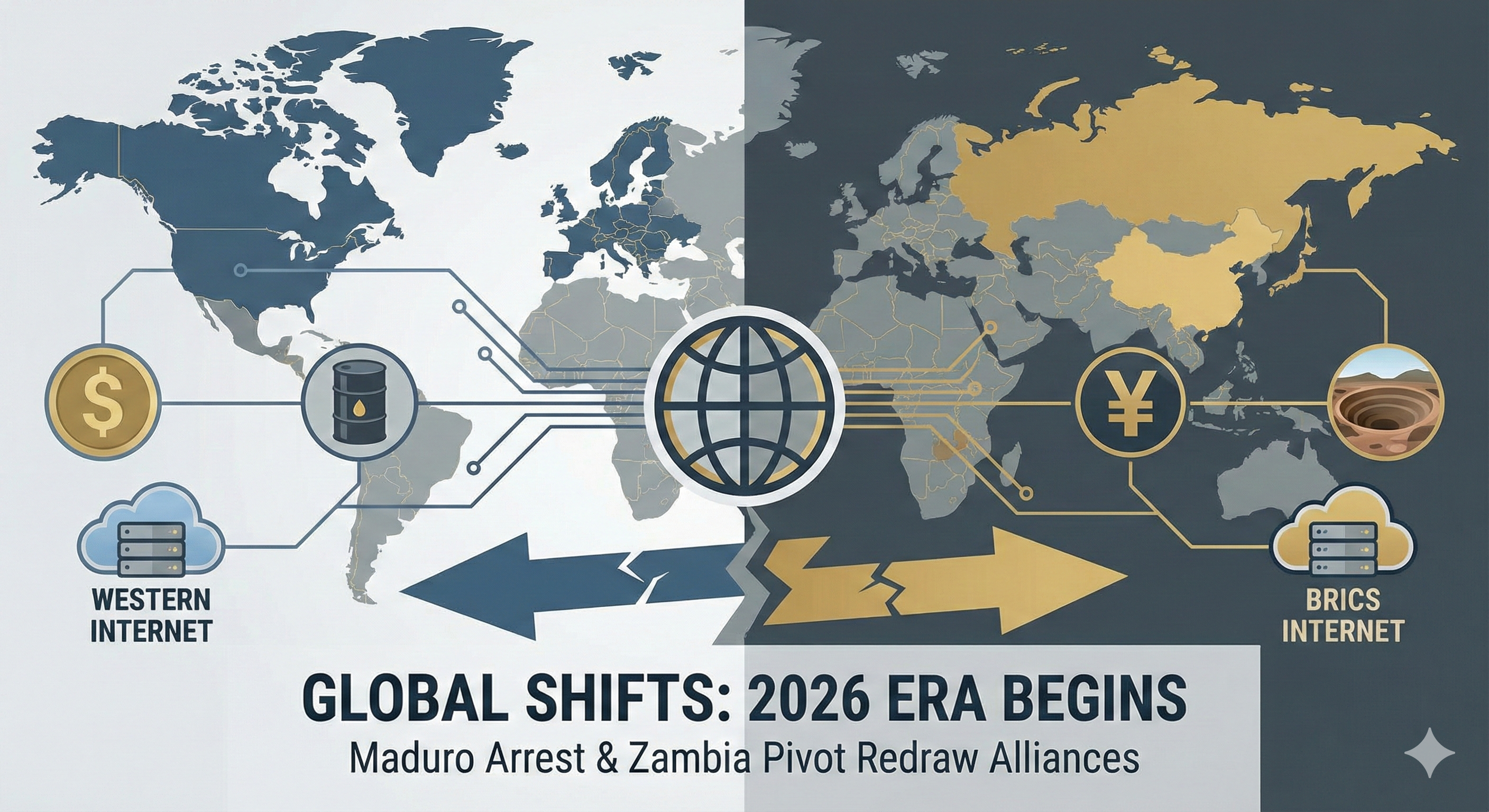
The bifurcation of the global economy into a "Dollar Zone" and a "Yuan Zone" will have immediate and devastating effects on the Global Internet Services industry. As nations like Zambia, and potentially South Africa and Nigeria, drift further into the BRICS economic orbit, we risk the acceleration of the "Splinternet."
Western technology firms may soon find it impossible to process payments or host data in these jurisdictions due to sanctions compliance. We are likely to see a rise in parallel digital infrastructures, where Chinese-backed fiber and 5G networks service the Yuan bloc, while Western firms are forced to exit high-growth African markets. For an interconnected digital economy, this fragmentation increases latency, costs, and cybersecurity risks for multinational corporations.
The Oil Shock and Energy Security
The energy sector has reacted with predictable volatility, with Brent Crude spiking to $92 a barrel upon news of the U.S. intervention in Venezuela. However, the long-term implications are far more severe.
With the U.S. signaling it will directly manage Venezuela’s vast reserves to stabilize the market, BRICS nations like Iran and Russia view this as an existential threat to their own energy leverage. Iran’s threat to close the Strait of Hormuz is no longer rhetorical; it is a survival strategy. For Brazil, a BRICS member with deep energy ties, the pressure to choose a side is immense.
The oil market is no longer driven by supply and demand but by allegiance and security clearance. Countries in the "Dictator’s Axis" of Zimbabwe and Nigeria, which rely heavily on resource extraction to fund their regimes, will find their exports scrutinized and potentially sanctioned if they do not fall in line with the new Western standards of governance.
Conclusion
The events of January 2026 have clarified the stakes. The world is separating into two distinct operating systems. On one side are nations that adhere to the U.S. dollar and Western legal jurisdiction; on the other are those gambling on the protection of a weakened BRICS alliance. For the leaders of South Africa, Nigeria, and Zimbabwe, the arrest of Maduro is a signal that the walls are closing in. For the global business community, the message is that political neutrality is no longer a viable strategy.
Date: January 3, 2026
The confirmation of Venezuelan President Nicolás Maduro’s detention by U.S. forces this morning has fundamentally altered the geopolitical landscape. This event, combined with the U.S. administration's immediate expansion of the immigration Exclusion List to include Zambia, marks the definitive end of the post-Cold War diplomatic order. For global industries, specifically Internet Services and Energy, the era of a unified global market is effectively over.
The repercussions are being felt most acutely in the Global South, where the leadership styles of Nigeria, South Africa, and Zimbabwe face a reckoning. The "dictatorial style" of governance in these nations, often characterized by the suppression of dissent and reliance on opaque patronage networks, has suddenly lost a key ideological and financial pillar in Caracas.
The End of the "Black Budget" and the African Impact
For years, intelligence analysts have pointed to a flow of illicit funds—often termed the "Black Budget"—moving between the Maduro regime and allied elites in Africa. The arrest of Maduro disrupts this network immediately. In Nigeria, South Africa, and Zimbabwe, ruling coalitions that have relied on anti-Western rhetoric to mask internal mismanagement now face a crisis of liquidity and legitimacy.
In South Africa, the Government of National Unity finds itself in a precarious position. Having long shielded controversial figures under the guise of diplomatic neutrality, Pretoria must now navigate a world where the U.S. has demonstrated it will physically dismantle regimes it deems criminal enterprises. The silence from the Union Buildings today is deafening, likely stemming from the realization that the immunity of sovereignty is no longer guaranteed for leaders who operate outside international legal norms.
Zambia and the Currency War
While the Caracas operation dominates the headlines, the economic war has opened a new front in Lusaka. Zambia’s decision to officially operationalize the acceptance of Chinese Yuan (Renminbi) for mining tax payments has triggered swift retaliation. The inclusion of Zambia on the U.S. Exclusion List, effective January 1, 2026, serves as a brutal warning to the rest of the continent: economic alignment with Beijing will come at the cost of access to the West.
This "Zambia Model" of de-dollarization poses a systemic threat to the U.S. financial hegemony. By allowing copper—a critical mineral for the green energy transition—to be traded and taxed in Yuan, Zambia has bypassed the U.S. dollar entirely. The U.S. response clarifies that the dollar is not just a currency but a national security instrument.
Impact on Global Internet Services
The bifurcation of the global economy into a "Dollar Zone" and a "Yuan Zone" will have immediate and devastating effects on the Global Internet Services industry. As nations like Zambia, and potentially South Africa and Nigeria, drift further into the BRICS economic orbit, we risk the acceleration of the "Splinternet."
Western technology firms may soon find it impossible to process payments or host data in these jurisdictions due to sanctions compliance. We are likely to see a rise in parallel digital infrastructures, where Chinese-backed fiber and 5G networks service the Yuan bloc, while Western firms are forced to exit high-growth African markets. For an interconnected digital economy, this fragmentation increases latency, costs, and cybersecurity risks for multinational corporations.
The Oil Shock and Energy Security
The energy sector has reacted with predictable volatility, with Brent Crude spiking to $92 a barrel upon news of the U.S. intervention in Venezuela. However, the long-term implications are far more severe.
With the U.S. signaling it will directly manage Venezuela’s vast reserves to stabilize the market, BRICS nations like Iran and Russia view this as an existential threat to their own energy leverage. Iran’s threat to close the Strait of Hormuz is no longer rhetorical; it is a survival strategy. For Brazil, a BRICS member with deep energy ties, the pressure to choose a side is immense.
The oil market is no longer driven by supply and demand but by allegiance and security clearance. Countries in the "Dictator’s Axis" of Zimbabwe and Nigeria, which rely heavily on resource extraction to fund their regimes, will find their exports scrutinized and potentially sanctioned if they do not fall in line with the new Western standards of governance.
Conclusion
The events of January 2026 have clarified the stakes. The world is separating into two distinct operating systems. On one side are nations that adhere to the U.S. dollar and Western legal jurisdiction; on the other are those gambling on the protection of a weakened BRICS alliance. For the leaders of South Africa, Nigeria, and Zimbabwe, the arrest of Maduro is a signal that the walls are closing in. For the global business community, the message is that political neutrality is no longer a viable strategy.
Discussion (0)
Please log in to post a comment.
No comments yet. Be the first to share your thoughts!