The Great AI Reset: When the Bubble Pops, Who Actually Gets Wet?
IT
•
December 1, 2025
•
47 Views
If you listen to the headlines, the sky isn't just falling—it’s being procedurally generated by an AI to fall more efficiently. We are currently living through the "AI Bubble Burst" scenario, a strange economic moment where the market is tight, the hype is loud, and the layoffs are bafflingly high.
It’s the "Great AI Scare" of 2025. We were promised that AI would do our laundry and taxes; instead, it’s writing our poetry, painting our art, and apparently, taking our jobs before it has even figured out how to draw hands correctly.
The Pink Slip Paradox
Here is the raw data that doesn’t make sense: Corporations are posting record profits, yet retrenchments are at an all-time high. Why? Because the "threat of AI" has become the ultimate scare tactic.
It feels eerily like the Dot-com bubble of 2000 or the Housing Crash of 2008, but with better graphics. In 2000, companies added ".com" to their name to boost stock prices; today, they add "AI" to their earnings calls to justify firing 15% of their workforce. It’s a preemptive strike against a future that hasn’t happened yet—a corporate panic attack disguised as "restructuring."
The Elephant in the Boardroom: Cowardly Leadership
Let’s address the massive, severance-package-protecting Elephant in the Room.
The real crisis isn’t the technology; it’s the volatility of leadership. We are seeing a generation of C-suite executives who are terrified of risk. Rather than innovating or upskilling their workforce to use these new tools, they are choosing the path of least resistance: layoffs.
It is a "defense-first" strategy. By cutting staff, they artificially inflate short-term margins, protecting those massive executive bonuses and stock options. It’s the equivalent of throwing the crew overboard to make the yacht lighter, rather than learning how to sail through the storm. They aren't leading; they are hiding behind the algorithm.
The Legal Landmine: "Ctrl+C, Ctrl+V" is Not Creativity
While leadership hides, the legal walls are closing in. The assumption that AI is a "safe" bet is crumbling under the weight of pending lawsuits.
We are seeing the Big Music and Big Publication bubbles fighting back. The legal cases against major players (like the ones targeting ChatGPT and image generators) are exposing a dirty secret: "Generative" often just means "Derivative." You can’t just change a pixel color, swap a style, or slightly alter a layout and call it original.
If the courts rule that training AI on copyrighted data is infringement, the entire economic model of these AI giants collapses. That "safe" investment might suddenly owe billions in royalties to the artists and writers it tried to replace.
The Content Tsunami: A Doorway or a Dead End?
Then there is the product itself. We are drowning in a massive volume of AI-generated video and imagery. The internet is flooding with synthetic content.
Is this a "new door down a corridor" of human expression? Or is it just a hallway filled with junk mail? The challenge isn’t creating content anymore; it’s finding something real amidst the noise. As we flood the zone with AI slop, the value of human connection and authentic creation is skyrocketing.
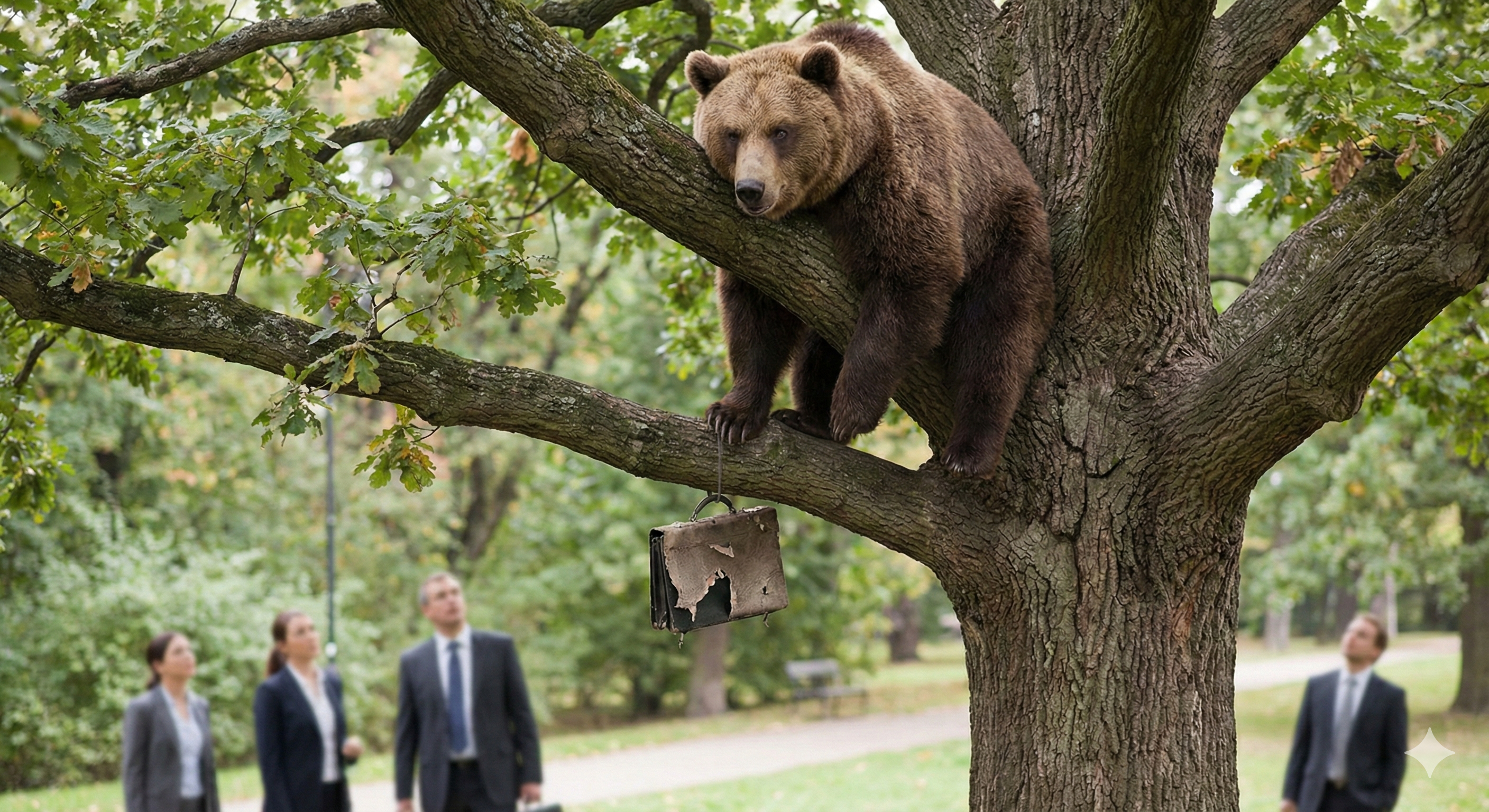
The Bear Up the Tree
So, where does that leave us? Are we looking at a total collapse, or just a "Bear up the tree"—scared, dangerous, but eventually coming down?
This feels less like the end of the world and more like a massive, painful re-adjustment. The business sector is evolving, trying to find its way through the fog. The companies that will survive aren't the ones firing everyone to save a buck today; they are the ones brave enough to keep their people, navigate the legal minefield, and use AI as a tool, not a replacement.
The bubble might be bursting, but the ground is still there. The question is: when the dust settles, will there be anyone left working to rebuild it?
It’s the "Great AI Scare" of 2025. We were promised that AI would do our laundry and taxes; instead, it’s writing our poetry, painting our art, and apparently, taking our jobs before it has even figured out how to draw hands correctly.
The Pink Slip Paradox
Here is the raw data that doesn’t make sense: Corporations are posting record profits, yet retrenchments are at an all-time high. Why? Because the "threat of AI" has become the ultimate scare tactic.
It feels eerily like the Dot-com bubble of 2000 or the Housing Crash of 2008, but with better graphics. In 2000, companies added ".com" to their name to boost stock prices; today, they add "AI" to their earnings calls to justify firing 15% of their workforce. It’s a preemptive strike against a future that hasn’t happened yet—a corporate panic attack disguised as "restructuring."
The Elephant in the Boardroom: Cowardly Leadership
Let’s address the massive, severance-package-protecting Elephant in the Room.
The real crisis isn’t the technology; it’s the volatility of leadership. We are seeing a generation of C-suite executives who are terrified of risk. Rather than innovating or upskilling their workforce to use these new tools, they are choosing the path of least resistance: layoffs.
It is a "defense-first" strategy. By cutting staff, they artificially inflate short-term margins, protecting those massive executive bonuses and stock options. It’s the equivalent of throwing the crew overboard to make the yacht lighter, rather than learning how to sail through the storm. They aren't leading; they are hiding behind the algorithm.
The Legal Landmine: "Ctrl+C, Ctrl+V" is Not Creativity
While leadership hides, the legal walls are closing in. The assumption that AI is a "safe" bet is crumbling under the weight of pending lawsuits.
We are seeing the Big Music and Big Publication bubbles fighting back. The legal cases against major players (like the ones targeting ChatGPT and image generators) are exposing a dirty secret: "Generative" often just means "Derivative." You can’t just change a pixel color, swap a style, or slightly alter a layout and call it original.
If the courts rule that training AI on copyrighted data is infringement, the entire economic model of these AI giants collapses. That "safe" investment might suddenly owe billions in royalties to the artists and writers it tried to replace.
The Content Tsunami: A Doorway or a Dead End?
Then there is the product itself. We are drowning in a massive volume of AI-generated video and imagery. The internet is flooding with synthetic content.
Is this a "new door down a corridor" of human expression? Or is it just a hallway filled with junk mail? The challenge isn’t creating content anymore; it’s finding something real amidst the noise. As we flood the zone with AI slop, the value of human connection and authentic creation is skyrocketing.
The Bear Up the Tree
So, where does that leave us? Are we looking at a total collapse, or just a "Bear up the tree"—scared, dangerous, but eventually coming down?
This feels less like the end of the world and more like a massive, painful re-adjustment. The business sector is evolving, trying to find its way through the fog. The companies that will survive aren't the ones firing everyone to save a buck today; they are the ones brave enough to keep their people, navigate the legal minefield, and use AI as a tool, not a replacement.
The bubble might be bursting, but the ground is still there. The question is: when the dust settles, will there be anyone left working to rebuild it?
Discussion (0)
Please log in to post a comment.
No comments yet. Be the first to share your thoughts!