Why Industry Depends on Student Immigration Reform
Top Story
•
May 10, 2026
•
15 Views
Why Industry Depends on Student Immigration Reform
For over a century, the United States has served as the world’s premier laboratory for innovation, fueled by a unique synergy between elite academic institutions and a dynamic free-market economy. This "American Miracle" has never been a solo act; it has always relied on the continuous arrival of global talent. However, as we navigate the complexities of 2026, the regulatory frameworks managed by the Department of Homeland Security (DHS) and U.S. Citizenship and Immigration Services (USCIS) face a critical inflection point. To maintain global dominance, the U.S. must transition from a posture of protectionist restriction to one of strategic human capital retention.
The Job-Creator Paradigm: From Classrooms to Boardrooms
The prevailing and fundamentally flawed narrative suggests that international talent is a threat to domestic employment. On the contrary, history and data prove that international students are not just job seekers; they are job creators. Consider the architectural shift in American industry led by those who arrived on our shores to study. Elon Musk moved from South Africa to Canada and eventually to the University of Pennsylvania as an international student; today, his ventures in Tesla and SpaceX employ tens of thousands of American workers and have revitalized the domestic aerospace and automotive sectors.
Musk is not an outlier. The founders of Google (Sergey Brin), NVIDIA (Jensen Huang), and modern tech pillars like Grammarly and Calendly all share roots in the immigrant experience or international education. These leaders did not simply "take" a job; they built vast economic ecosystems that support local manufacturing, logistics, and infrastructure. When we welcome a bright mind into a STEM program, we are potentially welcoming the founder of the next trillion-dollar industry.
The Economic Engine and the Weight of Sacrifice
The financial impact of international students is both immediate and staggering. Reports consistently show that international students contribute upwards of $40 billion annually to the U.S. economy, supporting nearly half a million jobs. This capital infusion reaches far beyond university bursar offices; it flows into local real estate, retail, and service industries in every state.
Yet, the economic data only tells half the story. We must recognize the profound human investment involved. Many international scholars arrive with their families, having sacrificed established careers and liquidating assets in their home countries to bet everything on the American dream. This "all-in" commitment breeds an unparalleled work ethic and a deep-seated drive to integrate and succeed. These families do not come to exploit; they come to build. In fields like AI orchestration, network architecture, and advanced physics, this level of dedication is the exact fuel required for industry-wide breakthroughs.
The Paradox of Exporting Excellence
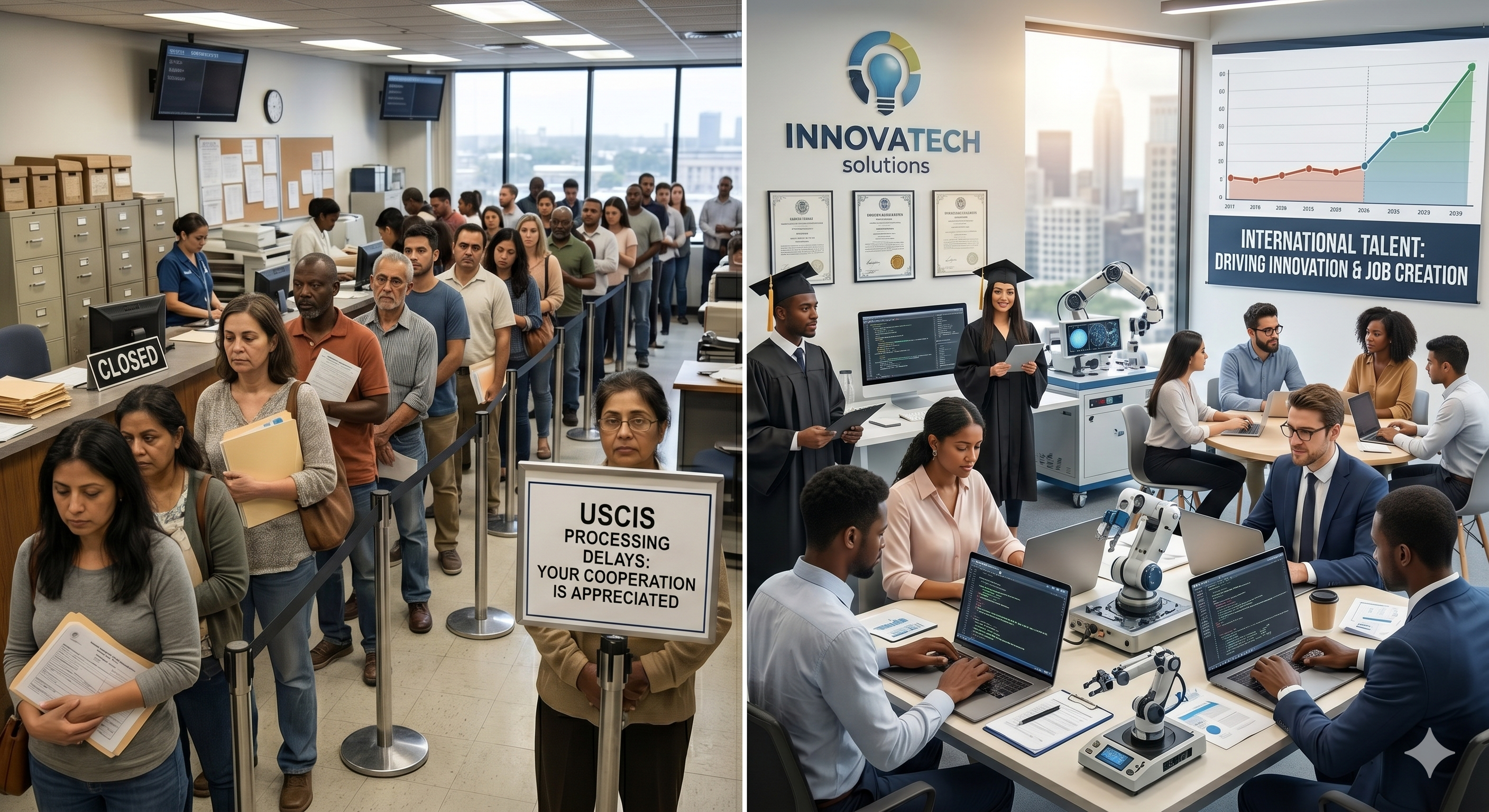
One of the most glaring systemic inefficiencies is the "Training Paradox." The U.S. education system spends billions in research grants and institutional energy to train the world’s most capable engineers and scientists. However, under current USCIS constraints such as rigid H1-B lotteries and the administrative hurdles of Optional Practical Training (OPT) we effectively force these highly trained individuals to take their American-acquired expertise to our global competitors.
From a business perspective, training an elite workforce and then mandating their departure is a recipe for stagnation. It is a self-inflicted "brain drain" that serves no one. When a graduate with a Master’s in Information Systems is forced to leave, they don’t just take their degree; they take the potential patents, the future startups, and the tax revenue that should have remained on American soil.
The Danger of Protectionist Ideologies
History warns us against the stagnation of "protectionist" bureaucracy. We have seen how entrenched systems from the historical "banana empires" that stifled regional competition to the rigid regulatory moats often seen in the military-industrial complex can eventually stunt the very growth they claim to protect. When a government becomes more focused on the "protection" of a status quo than on the "acquisition" of excellence, it loses its competitive edge.
The current global anti-immigration narrative is a seductive but dangerous distraction. While it is vital to ensure an orderly and legal process, the current complexity of the system actually creates the very "loss of control" that critics fear. A convoluted system invites chaos; a streamlined, merit-based, and transparent system demonstrates true administrative control.
Embracing Intent to Regain Control
It is time to move past the archaic requirement of proving "non-immigrant intent." We should view the desire of a student to stay, work, and build a life in the U.S. as a massive compliment to our nation and a victory for our economy. By providing a clear, simplified pathway from the graduation stage to permanent residency, the U.S. can stabilize its workforce and secure its lead in the global tech race.
The goal for DHS and USCIS should be to align their policies with the realities of 21st-century industry growth. By facilitating the stay of great minds and those seeking a better life through hard work, the United States ensures that the "Architects of Tomorrow" continue to build their empires here, reinforcing the foundations of American prosperity for generations to come.
Ryan S Taylor
MindTheDesk Contributor
(MSIS)(BSCIT)
CTO OSIBYTES GROUP LLC
Pyblox AI Architect
"AI assited and image generated article"
For over a century, the United States has served as the world’s premier laboratory for innovation, fueled by a unique synergy between elite academic institutions and a dynamic free-market economy. This "American Miracle" has never been a solo act; it has always relied on the continuous arrival of global talent. However, as we navigate the complexities of 2026, the regulatory frameworks managed by the Department of Homeland Security (DHS) and U.S. Citizenship and Immigration Services (USCIS) face a critical inflection point. To maintain global dominance, the U.S. must transition from a posture of protectionist restriction to one of strategic human capital retention.
The Job-Creator Paradigm: From Classrooms to Boardrooms
The prevailing and fundamentally flawed narrative suggests that international talent is a threat to domestic employment. On the contrary, history and data prove that international students are not just job seekers; they are job creators. Consider the architectural shift in American industry led by those who arrived on our shores to study. Elon Musk moved from South Africa to Canada and eventually to the University of Pennsylvania as an international student; today, his ventures in Tesla and SpaceX employ tens of thousands of American workers and have revitalized the domestic aerospace and automotive sectors.
Musk is not an outlier. The founders of Google (Sergey Brin), NVIDIA (Jensen Huang), and modern tech pillars like Grammarly and Calendly all share roots in the immigrant experience or international education. These leaders did not simply "take" a job; they built vast economic ecosystems that support local manufacturing, logistics, and infrastructure. When we welcome a bright mind into a STEM program, we are potentially welcoming the founder of the next trillion-dollar industry.
The Economic Engine and the Weight of Sacrifice
The financial impact of international students is both immediate and staggering. Reports consistently show that international students contribute upwards of $40 billion annually to the U.S. economy, supporting nearly half a million jobs. This capital infusion reaches far beyond university bursar offices; it flows into local real estate, retail, and service industries in every state.
Yet, the economic data only tells half the story. We must recognize the profound human investment involved. Many international scholars arrive with their families, having sacrificed established careers and liquidating assets in their home countries to bet everything on the American dream. This "all-in" commitment breeds an unparalleled work ethic and a deep-seated drive to integrate and succeed. These families do not come to exploit; they come to build. In fields like AI orchestration, network architecture, and advanced physics, this level of dedication is the exact fuel required for industry-wide breakthroughs.
The Paradox of Exporting Excellence
One of the most glaring systemic inefficiencies is the "Training Paradox." The U.S. education system spends billions in research grants and institutional energy to train the world’s most capable engineers and scientists. However, under current USCIS constraints such as rigid H1-B lotteries and the administrative hurdles of Optional Practical Training (OPT) we effectively force these highly trained individuals to take their American-acquired expertise to our global competitors.
From a business perspective, training an elite workforce and then mandating their departure is a recipe for stagnation. It is a self-inflicted "brain drain" that serves no one. When a graduate with a Master’s in Information Systems is forced to leave, they don’t just take their degree; they take the potential patents, the future startups, and the tax revenue that should have remained on American soil.
The Danger of Protectionist Ideologies
History warns us against the stagnation of "protectionist" bureaucracy. We have seen how entrenched systems from the historical "banana empires" that stifled regional competition to the rigid regulatory moats often seen in the military-industrial complex can eventually stunt the very growth they claim to protect. When a government becomes more focused on the "protection" of a status quo than on the "acquisition" of excellence, it loses its competitive edge.
The current global anti-immigration narrative is a seductive but dangerous distraction. While it is vital to ensure an orderly and legal process, the current complexity of the system actually creates the very "loss of control" that critics fear. A convoluted system invites chaos; a streamlined, merit-based, and transparent system demonstrates true administrative control.
Embracing Intent to Regain Control
It is time to move past the archaic requirement of proving "non-immigrant intent." We should view the desire of a student to stay, work, and build a life in the U.S. as a massive compliment to our nation and a victory for our economy. By providing a clear, simplified pathway from the graduation stage to permanent residency, the U.S. can stabilize its workforce and secure its lead in the global tech race.
The goal for DHS and USCIS should be to align their policies with the realities of 21st-century industry growth. By facilitating the stay of great minds and those seeking a better life through hard work, the United States ensures that the "Architects of Tomorrow" continue to build their empires here, reinforcing the foundations of American prosperity for generations to come.
Ryan S Taylor
MindTheDesk Contributor
(MSIS)(BSCIT)
CTO OSIBYTES GROUP LLC
Pyblox AI Architect
"AI assited and image generated article"
Discussion (0)
Please log in to post a comment.
No comments yet. Be the first to share your thoughts!